
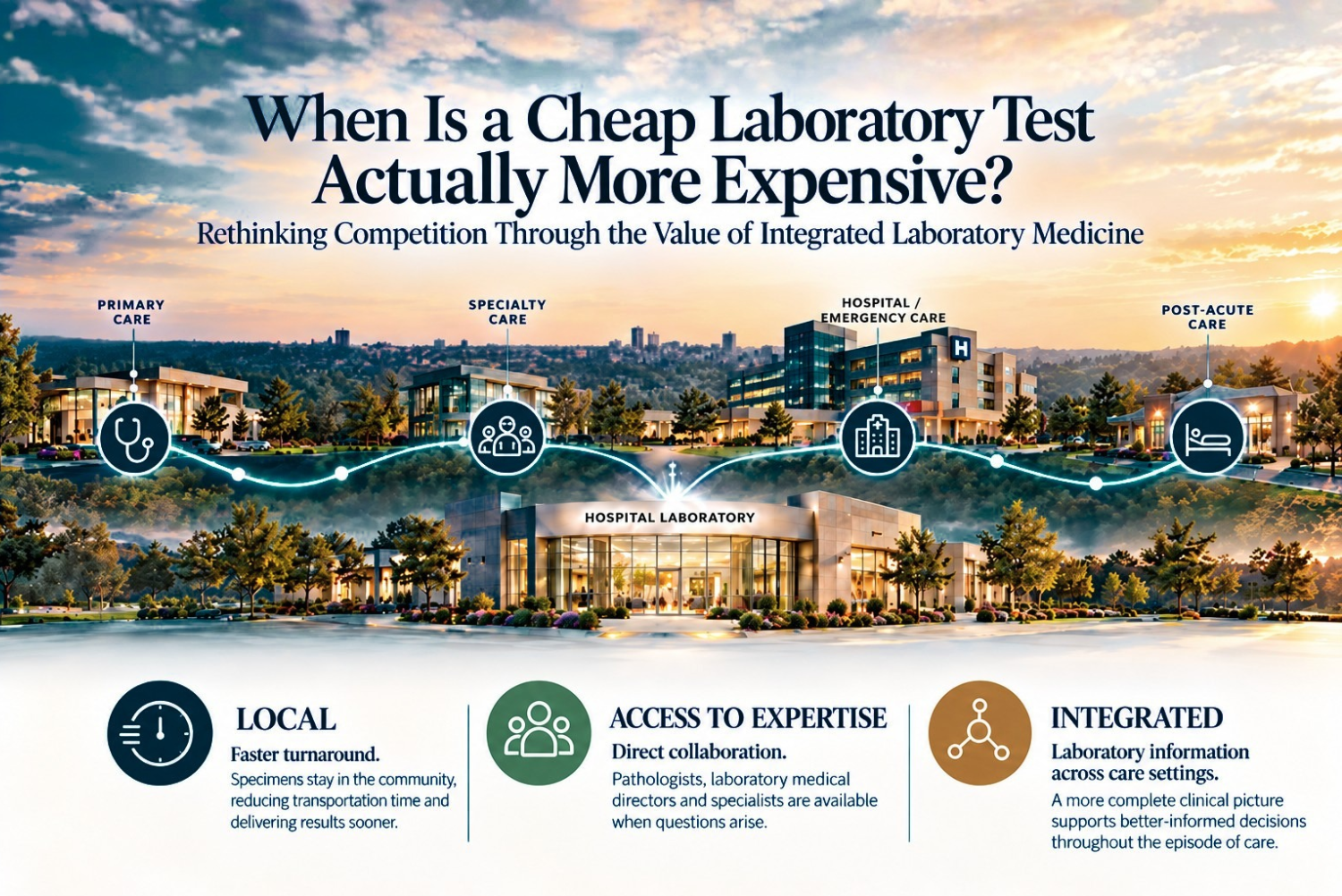
Rethinking Competition Through the Value of Integrated Laboratory Medicine
For many hospital laboratory leaders, competing for community laboratory testing can feel like a contest that favors large national commercial laboratories. Organizations such as Quest and LabCorp have enormous testing volumes, extensive logistics networks, substantial information technology infrastructure, and economies of scale that an individual hospital laboratory is unlikely to replicate.
Those advantages are formidable when laboratory testing is viewed primarily as a commodity and competition centers on scale, volume, and price per test. Hospital laboratories, however, have other competitive advantages.
The price of an individual laboratory test is relatively easy to identify. Its total cost and clinical value within an episode of care are more difficult to quantify. A lower-priced test can become more expensive when the savings on the testing transaction are exceeded by downstream costs associated with delayed decisions, repeated testing, or unnecessary care. The relevant economic comparison therefore extends beyond the unit price to what happens because of the laboratory information or lack thereof.
Laboratory information contributes to clinical decisions throughout an episode of care. Results help clinicians establish or refine diagnoses, determine whether additional testing is necessary, initiate or modify treatment, assess treatment response, and make decisions about admission, discharge, and follow-up care. These decisions recur as patients move between care settings. The timeliness, consistency, and availability of laboratory information can influence the decisions made and the resources required to deliver care.
This is not an argument against lower-priced testing. Efficient testing benefits patients and health systems alike. The question is whether the information needed for clinical decisions is available when needed, and whether any downstream clinical and operational consequences outweigh the savings on the individual test.
This distinction becomes even clearer as patients with chronic conditions move through primary care practices, specialist visits, ambulatory facilities, emergency departments, inpatient care, post-acute settings, and other care sites. Laboratory testing occurs throughout that journey, but results may not be readily accessible or sufficiently consistent to support reliable longitudinal trending as patients move between community care settings.
When testing is fragmented among unrelated laboratory providers and information systems, differences in methods and nomenclature can make results difficult to combine and trend. Previous results may be unavailable or not reliably comparable, making important changes harder to recognize and sometimes prompting repeat testing. Depending on the circumstances, the need to obtain or reconcile information can also delay decisions or require additional encounters and resources.
Contrast that with an environment in which laboratory results from primary care, specialty care, emergency departments, and hospitals are harmonized into a longitudinal, patient-centric diagnostic record. For example trends in hemoglobin, renal function, glucose, inflammatory markers, or tumor markers may become more apparent when results can be reliably compared over time. A test whose results contribute to this broader clinical picture may provide considerably greater value than a less expensive, isolated test that cannot be readily integrated into the patient's diagnostic history.
Diagnostic continuity is one potential advantage. Another, often underestimated, advantage is the hospital laboratory's local presence.
When the local hospital laboratory performs community testing, most specimens will remain within the community rather than traveling to a distant testing facility to achieve economies of scale. Local testing can improve total test turnaround time and reduce transportation-related specimen integrity risks. The economic importance of turnaround time depends on the decision awaiting the result, but delays in treatment, discharge, or other necessary action may consume resources whose cost may exceed the savings from a lower-priced test.
Local presence also creates opportunities for direct interaction with laboratory colleagues. Providers may seek guidance on test selection, unexpected results, or emerging diagnostic advances. Access to pathologists, laboratory medical directors, and scientists can support more informed decisions and potentially reduce unnecessary testing and other avoidable resource use. These interactions are generally most productive when questions concern testing performed by the local laboratory, where its staff have the greatest familiarity and expertise. This access may be especially valuable as nonphysician providers assume greater responsibility for ordering laboratory tests.
Taken together with diagnostic integration and continuity, these capabilities suggest a basis for competition that extends beyond unit price. W. Chan Kim and Renée Mauborgne’s (2005) work on Blue Ocean Strategy offers a useful perspective. Their framework encourages organizations to reconsider traditional dimensions of competition and explore different value propositions through value innovation. For hospital laboratories, the opportunity is to demonstrate how local testing, diagnostic continuity, and access to laboratory medicine expertise can enhance clinical decision-making support and care efficiency, creating a different basis for competition.
In that context, community laboratory market share may have value beyond additional testing volume and contribution margin. As a health-system laboratory expands its community outreach, more of a patient’s laboratory history may become available in a longitudinal, patient-centric diagnostic record. Greater market participation may therefore strengthen diagnostic continuity between community and hospital care settings by increasing the proportion of results generated by the same laboratory.
The value of increased market participation should therefore be evaluated not only through testing volume and laboratory contribution margin, but also through measurable improvements in clinical decision-making efficiency, care coordination, and health system performance.
This brings us back to the question posed at the beginning.
When is a cheap laboratory test actually more expensive?
When the lower purchase price is more than offset by additional costs elsewhere in the healthcare delivery system. These costs may result from delayed clinical decisions, unnecessary testing, fragmented diagnostic information that create operational inefficiencies, or diagnostic inconsistencies that contribute to unwarranted variation in care and avoidable resource utilization.
For decades, healthcare has become increasingly effective at measuring the unit cost of producing an individual laboratory test. We may be considerably less effective at measuring the economic consequences of the clinical decisions that laboratory information helps inform throughout an episode of care. Focused pilot studies can help determine whether improvements in diagnostic integration, test result consistency, and more timely access to laboratory medicine expertise translate into better clinical decisions, more efficient resource utilization, and lower overall costs.
This represents an important opportunity for local hospital laboratory staff. While unit test price remains important, the economic discussion should also ask:
What did the laboratory information enable us to do, and what was the impact on patient value and care efficiency?
If laboratorians engage in this discussion with evidence, they can demonstrate how the distinctive capabilities of hospital laboratories create measurable value for patients, clinicians, and health systems, while providing a stronger basis for competing in the community testing market.